
Where economics is heading
A dispatch from Paris

The workshop “Persistent Puzzles and Paradoxes in Economics: Are Radical Paradigm Changes on the Horizon?” brought together in Paris a diverse group of economists to discuss the future of the field. A French dispatch from Macrocosm researcher Marco Pangallo.
At Macrocosm, we argue for a scientific revolution in economics. This is about simulating households, firms, and banks in real time, reproducing real-world economic dynamics, whether you zoom in on a single economic actor or out to the whole economy.
This same vision was the unifying thread of an inspiring workshop held last week in Paris, “Persistent Puzzles and Paradoxes in Economics: Are Radical Paradigm Changes on the Horizon?”. Organized by Xavier Gabaix, Pershing Square Professor of Economics and Finance at Harvard University, and Jean-Philippe Bouchaud, co-founder, chairman and chief scientist at Capital Fund Management and member of the Académie des Sciences, it brought together fifteen speakers, each asked to lay out what they see as the major open problems in economics, and the methods best suited to tackle them.
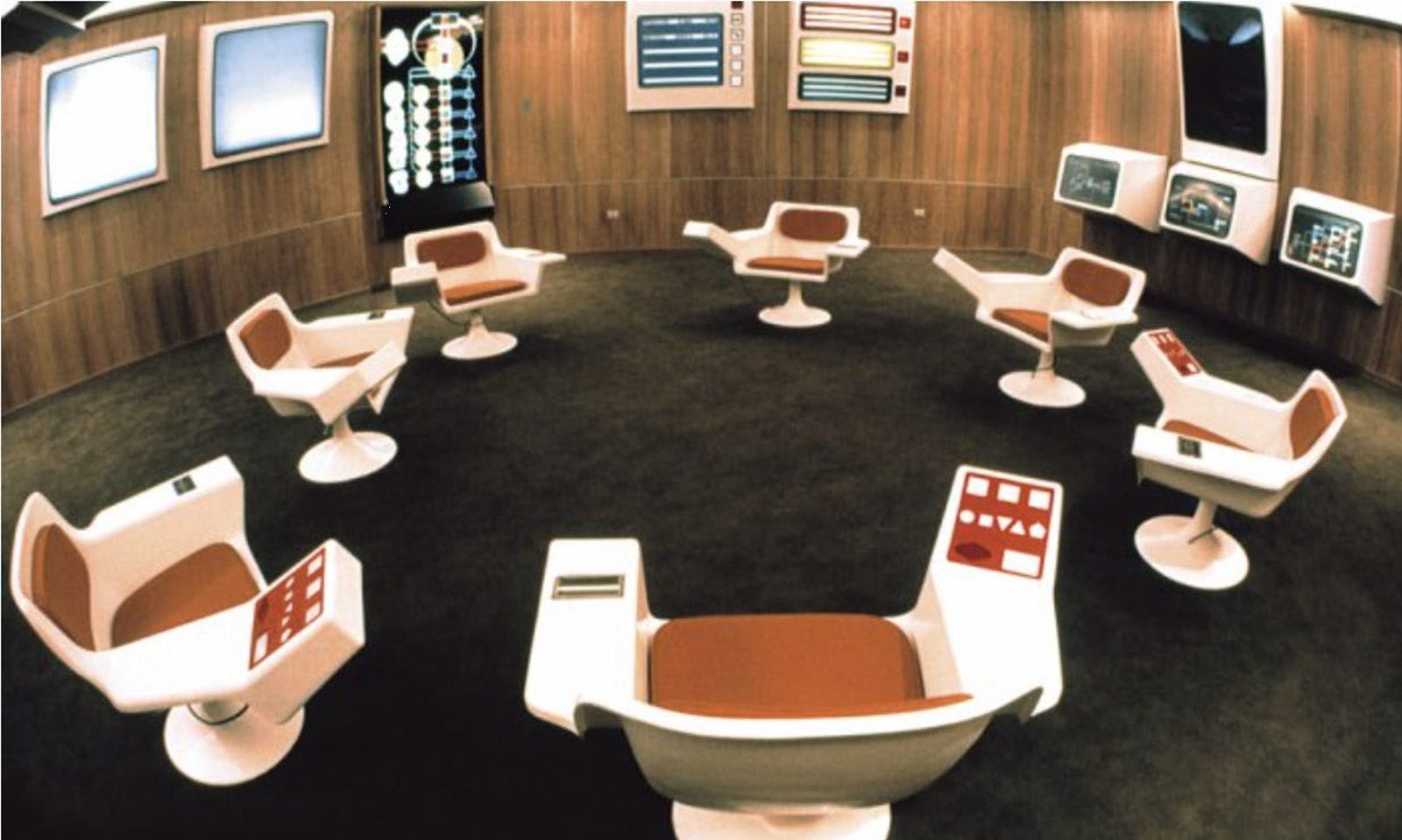
Vasco Carvalho, Professor of Macroeconomics at the University of Cambridge, gave the most vivid illustration of where the new paradigm is heading. He opened with the Control Room of Project Cybersyn, an attempt in 1970s Chile, under Salvador Allende, to build a cybernetic model of the economy: one that would ingest production and consumption data in real time into a simulation that could give directions for central control. Project Cybersyn didn’t work, as it was too far ahead of its time. Yet fifty years later, in the very same Chile, the Central Bank now receives, via mandatory electronic invoicing, every business-to-business and household-to-business transaction in the economy in real time, each exchange logged with the identities of buyer and seller, the product name, price, quantity, and payment terms. In several other countries we are starting to get similar data.
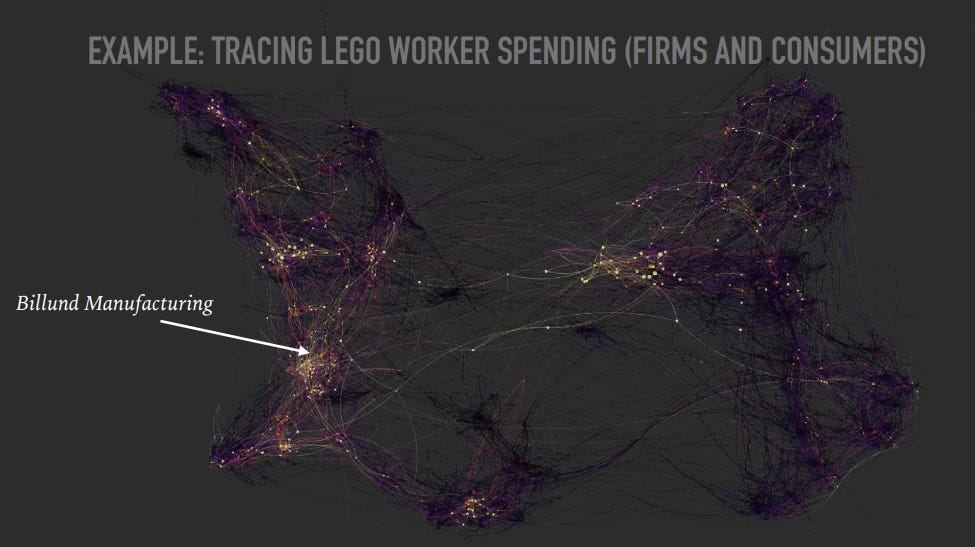
For instance, we can now disaggregate the national accounts of Denmark down to the level of workers in a given industry and municipality, as shown by Harvard Professor of Economics Ludwig Straub (winner of the most recent John Bates Clark Medal, awarded to an economist under 40 and often considered the most prestigious prize in the field after the Nobel). We can then simulate what would happen to manufacturing workers in Billund after a sudden rise in demand for the town’s main employer, Lego!
So has traditional economics already achieved what Macrocosm aims for? Not quite, there’s a subtle but important difference: the models behind these impressive results must respect equilibrium. This is a word with many meanings in economics, but essentially it means that a model has to satisfy many fixed-point constraints, as I discuss in a recent book chapter. For instance, demand must equal supply, or expectations must be consistent with the model’s own outcomes, what we call model-consistent, or rational, expectations. By contrast, the agent-based models we use at Macrocosm may settle into equilibrium over time, but they are not required to be in equilibrium from the start.
The equilibrium assumption is coming under increasing criticism, especially in models that unfold over time, since a static, one-shot equilibrium is far easier to solve. Benjamin Moll, Sir John Hicks Professor of Economics at the London School of Economics, reiterated at the workshop what he has been arguing for a while: in models with many heterogeneous agents, respecting the fixed-point constraints implied by rational expectations is both unrealistic and a computational nightmare. The ABMs we use at Macrocosm are far easier to simulate, and so can carry much more fine-grained heterogeneity. For instance, I showed how we can capture the subtle ways earnings and spending interact across age and income groups during the Covid-19 pandemic, an insight that would be much harder to reach with equilibrium models. Macrocosm’s founder Doyne Farmer showed several other success stories, such as housing markets and the 2008 crisis, leverage cycles, and clustered volatility in finance.
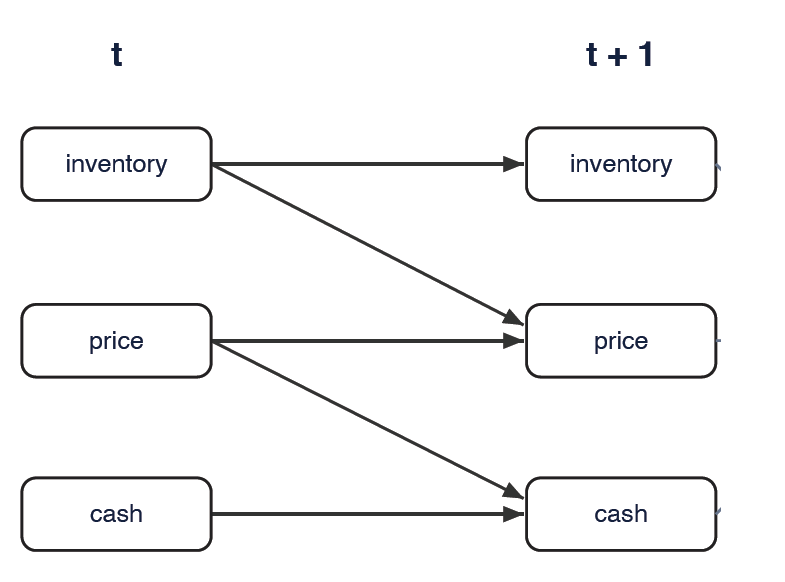
Mathematically, this flexibility of agent-based models can be represented as a directed acyclic graph, as my Macrocosm colleague Jose Moran argued, building on a recent paper by New York Fed researcher Keshav Dogra. It means that every variable at a given time t can be computed from its parents, typically variables at earlier steps. An equilibrium, by contrast, is a loop in the graph. Representing agent-based models this way also makes for a natural analogy with neural networks, and indeed at Macrocosm we are developing modern AI techniques to assimilate real-time data, finally fulfilling the dream of Project Cybersyn – stay tuned, more on this soon!
Summing up, all workshop participants, despite coming from very different traditions, agreed on the goal: build models from granular data that stay faithful to the real economy at every scale. Which models will get there first is a question for evidence. So the most concrete idea to come out of the two days was to build a shared leaderboard, in the spirit of the benchmarks that have driven so much progress in AI. Take a country’s disaggregated accounts over several consecutive years, and let many models compete on how well they predict them, in and out of sample, traditional and agent-based side by side. This would let the data decide what actually works.